Agenda
Venue Map (click to view)
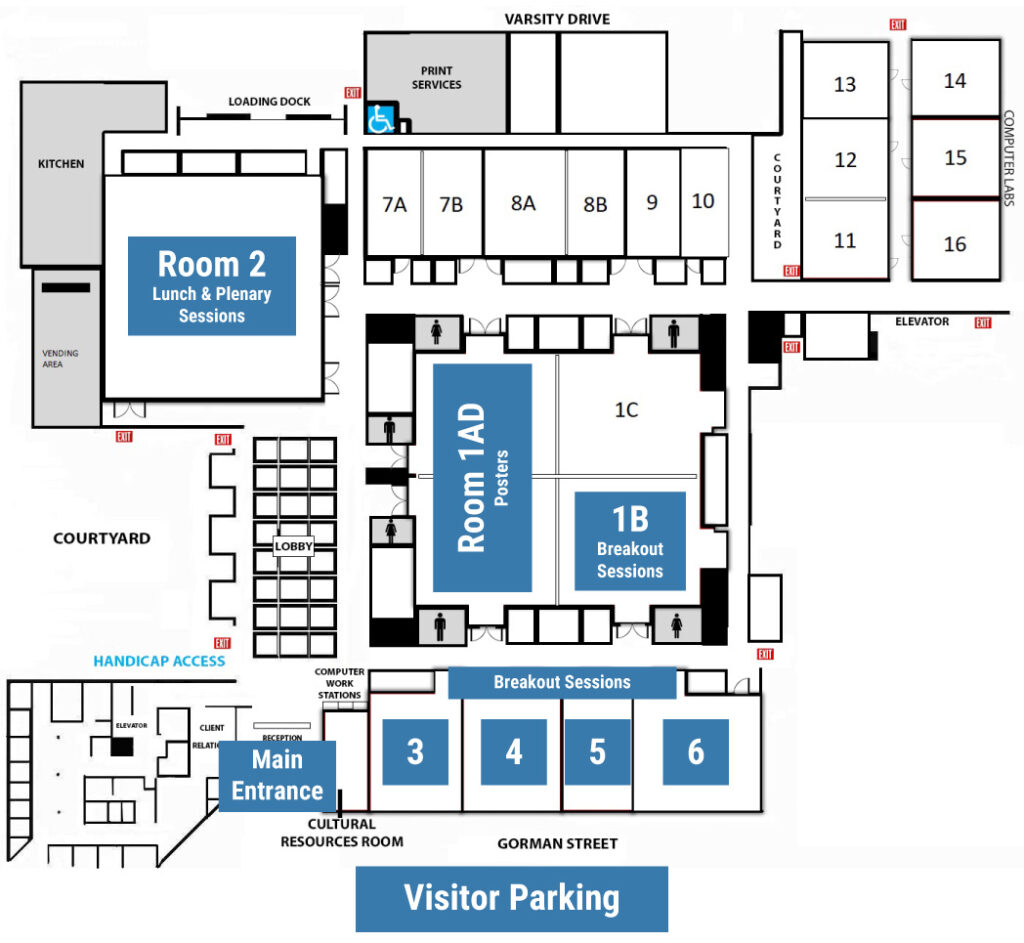
- The agenda below is subject to change.
- Send revision/update requests and questions to [email protected].
Day 1 – February 11, 2025
Registration, Breakfast, and Networking
8:00 am – 9:00 am
Welcome, Symposium Logistics, and Opening Plenary
Room 1AB
9:00 am – 10:00 am
Plenary topic: Data-Driven Discovery
Speaker:
Alyson Wilson
Interim Vice Chancellor for Research and Innovation
North Carolina State University
Data science, machine learning, and artificial intelligence are the hot buzzwords — and they are being touted as the solution for everything from curing cancer to self-driving cars. Data is driving discovery across disciplines at NC State; our motto is that “Data Science is for Everyone.” But is data science just another name for “big data”? I will discuss what data science is (and is not), some of the key principles of data science practice, and give examples that illustrate how data is changing scientific discovery.
Break
10:00 am – 10:15 am
Breakout Session 1
10:15 am – 11:30 am
Session 1, Strand A – Planning, Policy, and Resilience – Room 1AB
Moderator: Jessica Kuse
Ghosts of the Past: Restrictive Covenants and their Lasting Imprint on Raleigh’s Urban Equity
Sneha Bora (UNC Chapel Hill)
Bridging Racial Wealth Gaps through Bridges
Weilin He (Syracuse University)
Addressing Accessibility Barriers in Rural and Disconnected Communities
Venktesh Pandey and Komal Gulati (NC A&T University); Abhay Lidbe (University of Alabama)
Session 1, Strand B – Innovation, ML/AI, CAV, and UAS – Room 3
Moderator: Nick Short
Efficient Traffic Monitoring Using High-Resolution Aerial Images
Tewodros Gebre and Leila Hashemi Beni (NC A&T University
Using New Technology to Count Airplane Traffic at Municipal Airports
Chris Vaughan (NC State University)
Collegiate Underrepresented Business and Engineering Drone Training Intensive Program (CUBED TIP)
Laquanda Johnson, Oghenetejiri Ebakivie, and Rongfang Liu (NC A&T University
Session 1, Strand C – Environmental, Structures/Construction, and Pavement – Room 4
Moderator: Kurt Golembesky
Identifying optimal resilient transportation routes using visual data analytics, 2-D hydrodynamic modeling and high-resolution LiDAR data
Barbara Doll, Jack Kurki-Fox, and Dan Line (NC State University)
Validation of A Landslide Risk Predictor from Recent Hurricane Helene
Sophia Lin, Shenen Chen, Wenwu Tang, Ryan Rasanen, Craig Allen, and Nicole Braxtan (UNC Charlotte)
Hurricane Helene and the Wash-out of I-40: Observations From the Duke Great Smoky Mountains Rain Gauge Network
Douglas Miller, Caitlin Crossett, and Christopher Godfrey (UNC Asheville)
Onsite presentations for offsite sessions – Weather-related changes; expand for details
Due to weather, the offsite sessions will not actually be held offsite. The second part of “Walk a Mile in Someone Else’s Shoes” will now be held in Room 6 as a virtual walkthrough, and the second part of the UAS inspection demo has been canceled.
Walk a Mile in Someone Else’s Shoes – Accessibility Principles, Wayfinding, and Safety – Room 5
Bastian Schroeder (Kittelson & Associates), Sarah O’Brien (UNC Chapel Hill), and Alan Scott (Accessible Design for the Blind)
UAS Bridge / Structure Inspection Demo – Room 6
Ali Karimoddini (NC A&T University) and Tara Cavalline (UNC Charlotte)
Lunch and Panel Discussion
Room 2
11:30 am – 1:00 pm
Panel topic: Exploring Artificial Intelligence (AI) from Multiple Angles: Insights from Cybersecurity, Workforce Preparation, and Systems Engineering
This dynamic roundtable brings together thought leaders and experts to discuss the challenges, opportunities, and impacts of Artificial Intelligence (AI) for cybersecurity, workforce preparation, and systems engineering.
Speakers:
Dasha Davies – President/CISO, Stealth-ISS Group Inc.
Collin F. Lynch – Associate Professor of Computer Science, Department of Computer Science & The AI Academy, North Carolina State University
Miles Thompson – AI Assurance Solutions Lead, MITRE Corporation
Moderator:
Caitlyn Mabry – Data & Information Branch Manager in the Office of Strategic Initiatives and Program Support (SIPS), NCDOT
Tech Demos
Room 1CD
1:00 pm – 2:15 pm
Breakout Session 2
2:15 pm – 3:30 pm
Session 2, Strand A – Planning, Policy, and Resilience – Room 1AB
Moderator: Kim Nguyen
A Multi-Objective based Network Optimization during Emergency Resource Distribution
Nana Duah (NC A&T University)
Balancing the Transportation Needs of National Parks and Local Residents: A Case Study from North Carolina
Rongfang Liu (NC A&T University)
When the Wheels Stop Turning: Impacts of School Bus Disruptions in Durham
Samantha Pace (UNC Chapel Hill)
Session 2, Strand B – Innovation, ML/AI, CAV, and UAS – Room 3
Moderator: Sarah Searcy
Prediction of Retro-reflectivity of Traffic Signs
Gurcan Comert, Denis Ruganuza, Methuselah Sulle, Paul Olukoye, Judith Mwakalonge, Saidi Siuhi, and Nana Kankam Gyimah (NC A&T University / South Carolina State University)
Analyzing Factors Influencing Driver Willingness to Accept Advanced Driver Assistance Systems
Gurcan Comert, Hannah Musau, Judith Mwakalonge, Saidi Siuhi, Nana Kankam Gyimah (NC A&T University / South Carolina State University)
Reliable Vision-Based Perception for Control and Navigation of Automated Vehicle
Tesfamichael Getahun and Ali Karimoddini (NC A&T University)
Session 2, Strand C – Environmental, Structures/Construction, and Pavement – Room 4
Moderator: Andrew Wargo
Asphalt mixture performance property variations within mixture categories
Nooralhuda Saleh (Continuum Infrastructure Solutions)
Evaluation of High RAP Asphalt Mixtures and Binders with Recycling Agents
Cassie Castorena (NC State University)
Pavement Friction and Texture Performance Modeling
B. Shane Underwood and Boris Goenga (NC State University); Paul Rogers (KPR Engineering)
Session 2, Strand D – Integrated Mobility and Multimodal – Room 5
Moderator: Brennon Fuqua
Investigating Automated Shuttle Readiness for Rural Areas: A North Carolina Case Study
Oladimeji Alaka and Venktesh Pandey (NC A&T University)
Planning for connected and automated vehicles–more than engineering
Tab Combs (UNC Chapel Hill); Elizabeth Shay (Appalachian State University)
Pedestrian Crossing Treatment Hierarchy and Selection Guidance for Nevada DOT
John Shaw (NC State University)
Offsite Sessions – Weather-related changes; expand for details
Due to weather, the offsite sessions will not actually be held offsite. The second part of “Walk a Mile in Someone Else’s Shoes” will now be held in Room 6 as a virtual walkthrough, and the second part of the UAS inspection demo has been canceled.
Walk a Mile in Someone Else’s Shoes – Accessibility Principles, Wayfinding, and Safety – Room 6
Bastian Schroeder (Kittelson & Associates), Sarah O’Brien (UNC Chapel Hill), Alan Scott (Accessible Design for the Blind), and Chris Cunningham (NC State University)
UAS Bridge / Structure Inspection Demo
Ali Karimoddini (NC A&T University) and Tara Cavalline (UNC Charlotte)
Break
3:30 pm – 3:45 pm
Breakout Session 3
3:45 pm – 5:00 pm
Session 3, Strand A – Planning, Policy, and Resilience – Room 1AB
Moderator: Curtis Bradley
The Economic Contribution of North Carolina’s Supply Chain
Steve Bert (NC State University)
The Past Meets the Future: Integrating Evolving Geospatial and UAV Technologies into Cemetery Mapping
Timothy Mulrooney, Barron Allison, and Josue Millan (NC Central University)
Optimizing Freight Rail Networks for Decarbonization: A Comprehensive Approach Using A-STEP and Network Refinement
Md Abdullah Al Hasan (NC State University)
Session 3, Strand B – Innovation, ML/AI, CAV, and UAS – Room 3
Moderator: Riley Beaman
Safe Advanced Air Mobility: From Risk Assessment to Autonomous Mitigation of Mid-Air Collisions
Negasa Yahi (NC A&T University)
Urban Air Mobility Flight Operations Risk Assessment Based on Battery Energy Constraint
Yonas Ayalew, Abdul-Rauf Nuhu, Lydia Zeleke, Vahid Hemmati, Abdollah Homaifar, and Edward Tunstel (NC A&T University)
Security Risks in Urban Air Mobility: Evaluating Trojan Attacks on Autonomous Landing Systems
Reza Ahmari (NC A&T University)
Session 3, Strand C – Environmental, Structures/Construction, and Pavement – Room 4
Moderator: Nick Pierce
Strut-and-Tie Models for the Design of Bridge Bent Caps in North Carolina
Giorgio Proestos and Vishnu Punithavel (NC State University)
Towards the design of disturbed regions in bridge structures utilizing FRP reinforcement
Taylor Brodbeck, Ananna Sarker, Greg Lucier, Rudi Seracino, and Giorgio Proestos (NC State University)
Improved Live Load Distribution Factors for Load Rating of Slab and T-Beam Reinforced Concrete Bridges
Ghadir Haikal (NC State University); Faezeh Ravazdezh, Seungwook Seok, and Julio Ramirez (Purdue University); Jeremy Hunter and Jennifer Hart (Indiana Department of Transportation)
Session 3, Strand D – Integrated Mobility and Multimodal – Room 5
Moderator: Joe Furstenberg
Multi Modal Trip Reductions Rates in Local Municipalities
Daniel Coble (NC State University)
So close, yet so far: an automated method to identify missing links in pedestrian networks
Matthew Bhagat-Conway (UNC Chapel Hill)
User’s Preference for Trip Planner Interface and Factors Influencing Sustainable Transport Choices in Rural and Urban Areas
Ridwan Tiamiyu and Venktesh Pandey (NC A&T University)
Session 3, Strand E – Traffic, Safety, and Roadway Design – Room 6
Moderator: Joe Hummer
Continuous Flow Intersection Safety Evaluation
Christopher Cunningham (NC State University); Taha Saleem and Raghavan Srinivasan (UNC Chapel Hill)
An Estimate of the Potential Crash Savings from Optimizing the Design of Every Intersection
Joe Hummer (NCDOT)
Safe System Implementation: Current Prospects and Opportunities in the United States
Seth LaJeunesse (UNC Chapel Hill)
Day 2 – February 12, 2025
Registration, Breakfast, and Poster Setup
7:30 am – 8:30 am
Breakout Session 4
8:30 am – 9:45 am
Session 4, Strand A – Planning, Policy, and Resilience – Room 1B
Moderator: Alyson Tamer
Resilient and Sustainable Transportation Session
The Rainfall, Intensity, Duration, and Return for Observations and Projections (RaInDROP) Tool for North Carolina
Jared H. Bowden (NC State Climate Office)
Natural Hazards Vulnerability Assessment of the NCDOT Ferry Division Assets
Tim Brock (NC State University) and Beth Sciaudone (Moffat & Nichol)
Topology and Resilience: A Geospatial Analysis of Transportation Network In North Carolina
Trung Tran (Fayetteville State University)
A Review of Best Practices for Natural Disaster Infrastructure Recovery to Inform Hurricane Helene Recovery Strategy in Western North Carolina
Mary Warren and Tim Brock (NC State University)
Session 4, Strand B – Innovation, ML/AI, CAV, and UAS – Room 3
Moderator: Sarah Searcy
UNC Charlotte Automated Shuttle Pilot Study: Perceptions, Operational Performance and Lessons Learned
Srinivas Pulugurtha (University of Mississippi); Suzanna Leland, Amirhossein Ghasemi, Ninad Gore, Abhinav Grandhi, Mohammadnavid Golchin, Dil Samina Diba, and Rose Thomalen (UNC Charlotte)
Project OVAL (On-campus Vehicle Autonomous Launch)
Jimin Yu, Cole Malinchock, Jack Elia, Pratik Thapa, and Suchir Madap (NC State University)
Session 4, Strand C – Environmental, Structures/Construction, and Pavement – Room 4
Moderator: Matt York
Mapping the Invisible: Predicting Stormwater Pipelines Using Artificial Intellegence
Tianyang Chen (UNC Charlotte)
Deep Learning in Infrastructure Performance Monitoring
Don Chen and Wenwu Tang (UNC Charlotte); Christopher Vaughan (NC State University)
Session 4, Strand D – Integrated Mobility and Multimodal – Room 5
Moderator: Darcy Downs
Investigation of Technology to allow the tracking of wait times and traffic points of origin for users of the Ferry System
Daniel Coble (NC State University)
A Multi-Objective Optimization based Single Truck-Multiple Drone Delivery
Lidia Zewde (NC A&T University)
Exploring Public Wi-Fi Log Data and Microtransit Data to Understand City-Level Travel Demand for Enhancing Microtransit Services in North Carolina
Lei Zhu and Rachael (Yuqiu) Yuan (UNC Charlotte)
Session 4, Strand E – Traffic, Safety, and Roadway Design – Room 6
Moderator: Daniel Carter
Camera-based Work Zone Intrusion Alert System
Erol Ozan (East Carolina University)
Operational and Benefit-Cost Analysis of Intersections with Three-Phase Traffic Signals
Hayden Edwards (VHB)
Poster Presentations, Student and Professional Networking, and Refreshments
Room 1AD
9:45 am – 11:00 am
Poster Titles and Abstracts
Breakout Session 5
11:00 am – 12:15 pm
Session 5, Strand A – NCDOT Center of Excellence – Sustainable and Resilient Transportation – Room 1B
Moderator: Nastasha Earle-Young
NC Resilient and Sustainable Transportation COE (NC SuRe Center)
NC SuRe Infrastructure Center of Excellence Overview
Tim Brock (NC State University)
Creating More Climate Resilient Roads in North Carolina and COE Project 1 Update
Shane Underwood (NC State University)
An Agent-Based Model for Assessing Electric Vehicle Charging Infrastructure Capacity and Performance along Critical Transportation Corridors and Project 2 Update
Alexander Yoshizumi and Heather Brutz (NC State University)
Cyber-Resilient Traffic Management Centers: Enhancing Security for Intelligent Transportation Systems Project 3 Update
Shoaib Samandar (NC State University) and Sambit Bhattacharya (Fayetteville State University)
Session 5, Strand B – NCDOT Center of Excellence – Advanced Air Mobility – Room 3
Moderator: Jason Schronce
North Carolina Advanced Air Mobility Center of Excellence
Presenters TBA
Session 5, Strand C – NCDOT Center of Excellence – Connected and Autonomous Vehicles – Room 4
Moderator: Curtis Bradley
NC Transportation Center of Excellence on Connected and Autonomous Vehicle Technology (NC-CAV)
Presenters TBA
Session 5, Strand D – Integrated Mobility and Multimodal – Room 5
Moderator: Hart Evans
Got bikes? Traffic Gardens Grow Safe Road Users
Ellen M. Walston (ECU Health Medical Center)
Evolving Complete Streets into Smart(ER) Corridors
Ashley Thompson (Stantec)
Pedaling Toward the Future: Insights on North Carolinians’ E-Bike Aspirations from the Ral-E-Bike Program
Matthew Palm (UNC Chapel Hill)
Session 5, Strand E – Traffic, Safety, and Roadway Design – Room 6
Moderator: Daniel Carter
Utilizing Emergency Medical Services (EMS), Emergency Department (ED), and Linked Crash-EMS and Crash-ED Data to Inform Local and State Traffic Injury Prevention
Katherine Harmon and Yuni Tang (UNC Chapel Hill)
Insights and opportunities for transportation and public health agency collaboration to improve road safety
Elyse Keefe, Nandi Taylor, and Laura Sandt (UNC Chapel Hill)
The Value of Proactive Safety: Revisiting High Injury Networks
Ian Hamilton and Lauren Blackburn (VHB)
Lunch, Poster Awards, and Plenary Presentation
Room 2
12:15 pm – 1:45 pm
Plenary topic: Hurricane Helene Impacts and Rebuild Efforts
Speaker:
Alyson Tamer
Program Support Manager
WNC STRONG
North Carolina Department of Transportation
Hurricane Helene caused extensive destruction in western North Carolina, including over 9,000 damage sites. Hear about NCDOT’s comprehensive approach to statewide disaster recovery and the innovative delivery methods employed to rebuild the affected infrastructure.
Break
1:45 pm – 2:00 pm
Workshops
2:00 pm – 3:30 pm
Keys to a Successful & Implementable Research Project – Room 1B
Curtis Bradley
Research Implementation Manager
NCDOT
NCDOT manages between 60 – 80 research projects within its work program. The subjects of these projects range from Traffic & Safety, Pavement & Materials, Structures & Bridges, Environmental & Hydraulics as well as Planning & Multimodal. While the subjects of these projects may be diverse, there are common themes when it comes to the successful delivery of these research projects as well as key determining factors that lead to implementation. This session will highlight the importance of establishing a vision of the end product at the beginning of the research project, on-time delivery of deliverables, coordination with vested stakeholders, as well as follow-up methodologies that lead to the implementation of these research projects. The audience can expect to hear from multiple subject matter experts including (but not limited to), state / federal government, academic and private sector speakers.
Fully Autonomous Vehicle (FAV) Committee Meeting – Room 5
This committee meeting is open to attendance by interested attendees
Sarah Searcy
Emerging Technologies and Innovation Manager
Office of Strategic Initiatives and Program Support (SIPS)
North Carolina Department of Transportation